Pack orders from every channel in one pass
Watch a multi-channel seller process a morning's orders and you will see the real cost of selling on three platforms. It is not the commission. It is the tab-switching. Shopee seller centre for the Shopee orders, Lazada for the Lazada orders, TikTok for the TikTok orders, each with its own screen, its own export, its own way of marking a parcel ready. Three small jobs instead of one medium one, and the overheads of starting and stopping each job are pure waste.
The sellers who ship fastest run a different shape of morning. One list, one picking walk, one packing run, regardless of where the orders came from.
The one-list method
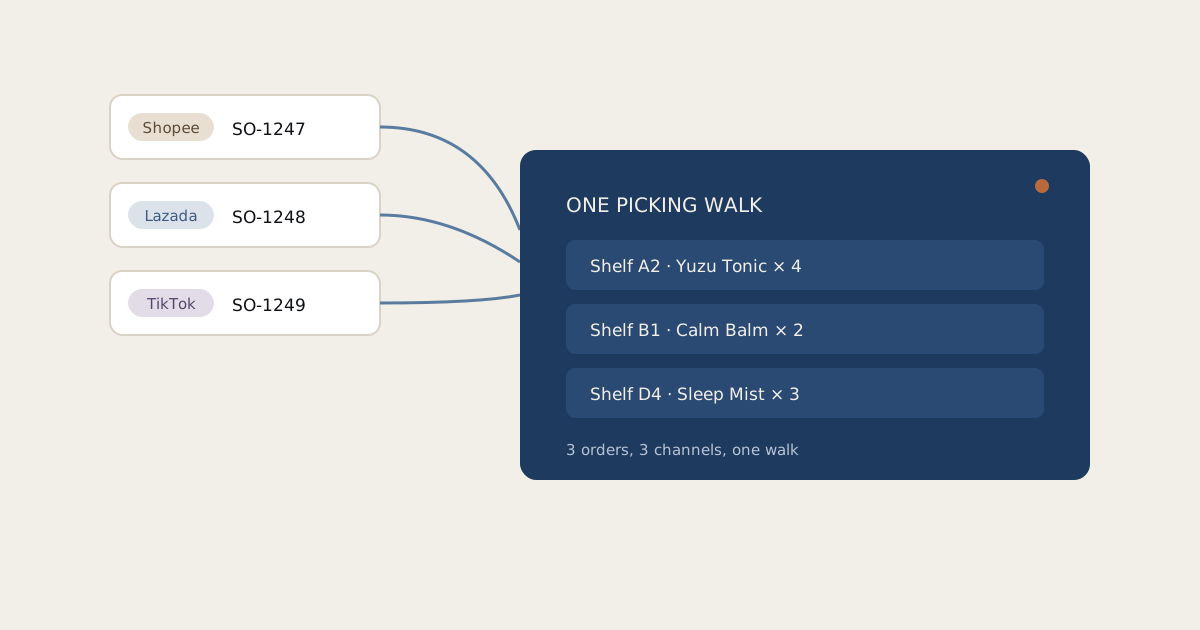
Step 1: every order in one queue. Before anything gets picked, all of yesterday evening's and this morning's orders need to be in a single list, whatever the channel. Sorted by status, not by platform. An order's platform matters to the courier label. It should not matter to the person picking.
Step 2: pick once, by location. From the combined list, build one picking list organised by where items sit on your shelves. If the same SKU appears in a Shopee order, two Lazada orders and a TikTok order, you visit its shelf once and pick four units, not four separate times in four separate sessions. On a 60-order morning with overlapping SKUs, this is the single biggest time saving available, and it is only possible when the orders are in one list to begin with.
Step 3: pack against the list, not the platform. Work through the queue in one run. The order's channel determines which label gets printed, and nothing else about your movements.
Step 4: mark shipped from the same screen. The final tab-switching trap is updating each marketplace afterwards. If your tool updates the marketplace when you mark the order shipped, the day ends when the last parcel is sealed. If it does not, your packing run has a second shift of data entry hiding behind it.
Same-buyer orders are free money
Multi-channel sellers see this weekly. The same customer places two orders within an hour, sometimes on the same channel, sometimes on your Shopify store and your WooCommerce store. Shipped separately, that is two parcels, two courier fees, two chances of damage. Combined, it is one.
Spotting these by eye across separate seller centres is close to impossible, which is why most sellers ship them separately and absorb the cost. In one combined queue, same-recipient orders sit next to each other and can be merged into a single shipment before picking starts. Even two combined orders a week pays a meaningful slice of a courier bill over a year.
Returns are part of the run, not an interruption
A returned parcel takes the same walk in reverse. Receive it, check it, and put sellable units back into stock so every channel can sell them again. The common failure is the half-return: refunded on the marketplace, never restocked, so the unit sits in a tub while every channel shows it as gone. If your process has a returns tub that gets "sorted out later", later is where your stock accuracy goes to die. Scan the return in the same session you receive it, and damaged units get marked damaged rather than silently vanishing.
What the arithmetic says
Take a morning of 80 orders across Shopee, Lazada and TikTok Shop. Run as three platform sessions, each carries its own start-up cost: open the seller centre, export or read the list, build a partial pick, pack, update statuses. Run as one queue, the start-up cost is paid once and the picking walk consolidates every overlapping SKU. Measured against switching between platforms, processing from one list is around 3x faster, and a campaign day stops being a different kind of day. It is an ordinary morning that runs longer.
Where Zeemarq fits
Zeemarq's order screen is that single queue. Orders from Shopee, Lazada, TikTok Shop, Amazon, Shopify and WooCommerce land in one list as they happen, same-recipient orders can be combined into one shipment, marking shipped updates the marketplace, and returns scan back into the same stock count every channel reads from. The free plan needs no card. Bring one ordinary morning's orders into it and time the difference yourself. See how the order flow works.